Emissions Community LiDAR Exploratory Project
In the South Bronx and the North Shore of Staten Island, residents suffer from disproportionately high asthma rates.
Gaps in local emissions records make it difficult to monitor air pollution effectively, leaving underrepresented communities — especially those near trucking routes, industrial facilities, and waste sites — vulnerable to ongoing poor air quality.
Columbia World Projects is working to close this gap by leveraging the latest technology and expertise from the Columbia Climate School and School of Engineering and Applied Science to increase the availability of local data for evidence-based decision-making.
Monitoring Neighborhood Air Quality with Precision
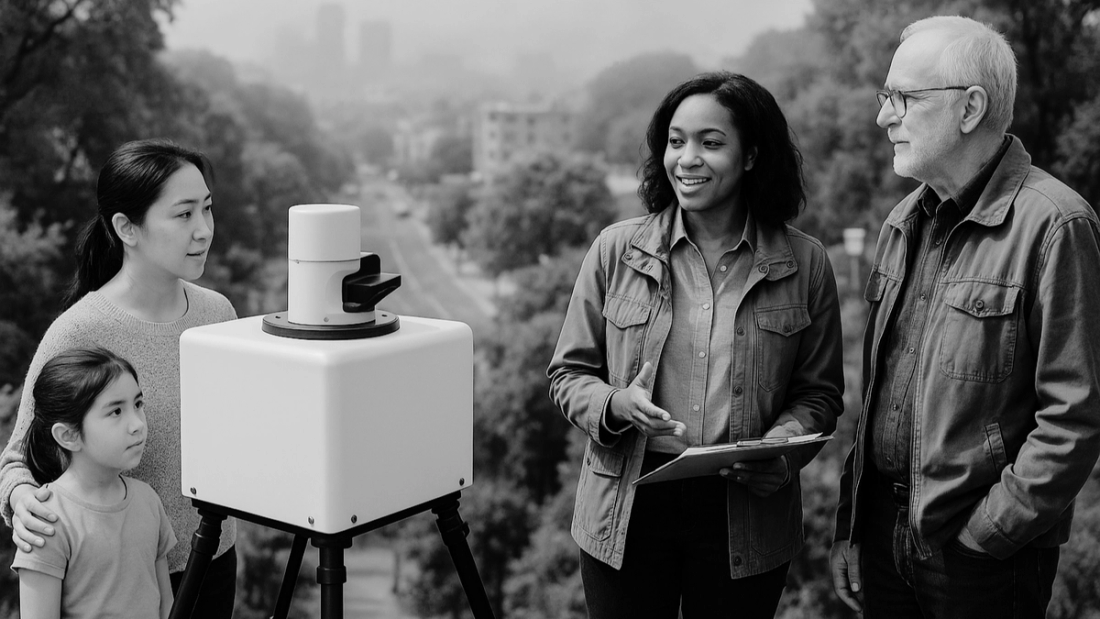
By deploying ground-based Light Detection and Ranging (LiDAR) technology, this project aims to capture high-resolution, hyper-local pollution data that traditional models often miss. Working in close collaboration with South Bronx Unite and the Staten Island Urban Center, the project team is stationing instruments in collaborating communities to provide continuous monitoring of particulate matter.
Results are then integrated with physics-based models to expand emissions inventories, enabling policymakers to take action in support of community health and equity. Ultimately, the project aims to create a scalable blueprint for community-centered air monitoring that can be scaled to cities around the world.
Project Leads
Marco Giometto
Assistant professor in the Civil Engineering and Engineering Mechanics department, Columbia University
Marco Giometto is an assistant professor in the Civil Engineering and Engineering Mechanics department at Columbia University and an Amazon Scholar. He studies both fundamental and applied problems related to fluid dynamics and turbulence, with an emphasis on atmospheric boundary layer processes.
Kytt MacManus
Applied Science Lead in the Environmental Flow Physics Lab, Columbia University School of Engineering and Applied Science
Kytt MacManus is a geospatial data scientist and educator with over 15 years of experience at the intersection of remote sensing, environmental policy, and urban sustainability. He currently serves as the Applied Science Lead in the Environmental Flow Physics Lab (EFPL) at Columbia University’s School of Engineering and Applied Science, where he focuses on urban climate and air quality.
Paul Gallay
Resilient Coastal Communities Project Director, Columbia Climate School
Paul Gallay directs the Resilient Coastal Community Project, a partnership between the Columbia Climate School’s Center for Sustainable Urban Development and the New York City Environmental Justice Alliance working to foster actionable, equitable solutions to climate-driven flood risks while advancing complementary goals like habitat restoration, community cohesion, and restorative justice. He is also a member of the faculty of Columbia’s Undergraduate Program in Sustainable Development.
Gregory Yetman
Associate director for the Geospatial Applications Division at the Center for Integrated Earth System Information, Columbia Climate School
Greg Yetman is associate director for the Geospatial Applications Division at CIESIN. He is a geographer specializing in the application of geographic information system (GIS) technologies in applied and research fields, including population geography, natural disasters, and environmental assessment.
