Between Academia and the World
Bridging the gap between academic theory and lived experience is a necessity for modern education.
Across universities nationwide, there is a widespread perception that interest in disciplines long considered the backbone of the humanities — classics, literature, philosophy, languages, history, and religion — has sharply declined, and that students no longer see how the knowledge produced by these fields is relevant in today’s world.
And yet, if we conceive of the humanities in the broader spirit of Columbia University’s Core Curriculum — as an effort to “grapple with the insistent problems of the present” — a paradox emerges: outside academia, the humanities are thriving. We are living in a moment marked by intense debates about memory, democracy, belonging, history, and even our shared humanity. How might we bridge this gap? A public humanities program focusing on Greece may point to possible answers.
The Stavros Niarchos Foundation Public Humanities Initiative (SNFPHI) at Columbia University was established in 2019 as part of the Institute for Ideas and Imagination to serve as a laboratory for engaged humanities at Columbia and a source of much-needed financial support and intellectual exchange for Greek artists, educators, and community leaders in the aftermath of the financial crisis. SNFPHI projects have created new opportunities for global engagement and expanded the boundaries of what public humanities can be — from a new shadow-theater play drawing on archival research on the Greek-Turkish War of 1919–1922 performed in a parking lot to the creation of a hip-hop album based on the oral history of Victoria Square in Athens.
Presenting this work on campus and giving SNFPHI awardees the opportunity to workshop new ideas with faculty and students on campus doesn’t just bring the world to Columbia but also establishes a practice of knowledge co-production with actors outside academia. This spring semester, members of Boulouki, a traveling workshop of architects, engineers, and conservationists reviving traditional building techniques, will discuss Farmer-Excavators, a project centered on the creation of an online archive about the important role that farmers played in the excavation of the ancient sanctuary on the island of Delos. As part of their visit, they will also offer a workshop at the School of Architecture on traditional construction methods.
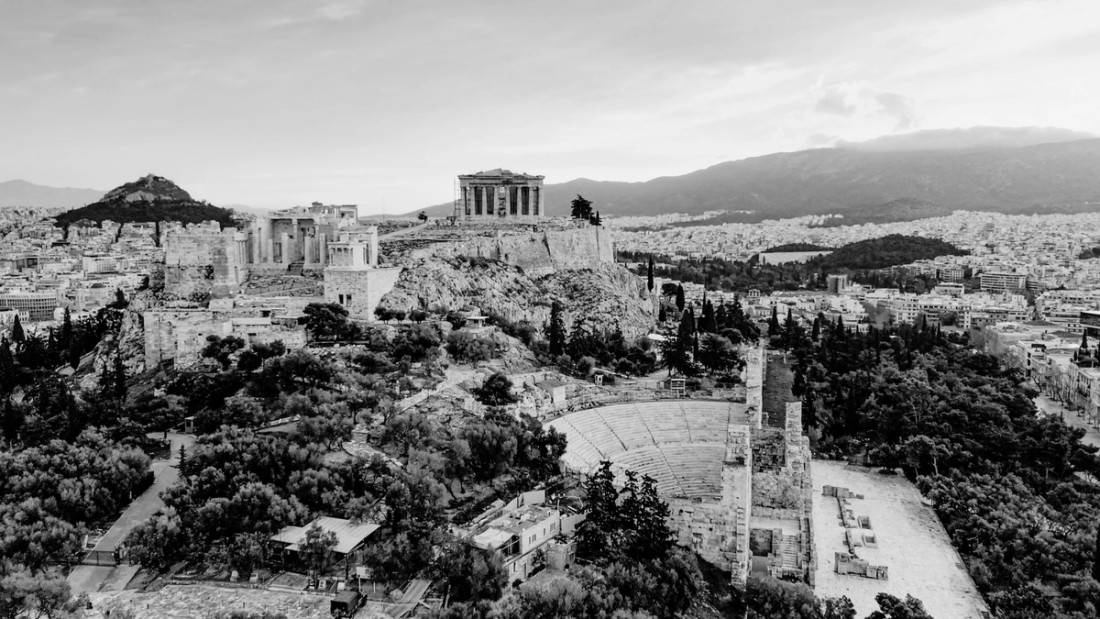
This exchange between Columbia and Greece points to a pedagogy that connects academic humanities to the world. This summer, undergraduate students participating in the Columbia Summer Global Core in Athens: Curatorial Project studied Greek history and topography and curated an exhibition about the building that will host the university’s Global Center in Athens. Drawing on what they were learning on the ground, they worked with SNFPHI local partners to research the building’s history in Greek political and economic life, learn oral history methods, conduct interviews and copyright research, and create a film and promotional materials. This is one example of how Columbia undergraduate students can benefit from expanding their scholarship through the University’s Global Centers around the world.
This experience gave participating students, most of them likely to be future computer scientists, engineers or doctors, the opportunity to see the relevance of humanistic inquiry beyond campus while acquiring hands-on practical and transferable skills and working with people they never would have met otherwise. Studying in Athens facilitated an important understanding that students brought back to campus: the pursuit of humanistic knowledge leads to the acquisition of concrete skills, creates adaptable thinkers, and serves as a generative means of engaging with a place, a culture, and a community. This is central to Columbia Global’s priority of bringing Columbia to the world and the world to Columbia.
Dimitris Antoniou is the Associate Director of the Stavros Niarchos Foundation Public Humanities Initiative. Antoniou (D.Phil., University of Oxford, 2011) studied theology at the University of Athens, anthropology at Princeton, and oriental studies at Oxford. Before joining the Program in Hellenic Studies, he was a Faculty Research Fellow at Oxford, a Hannah Seeger Davis Fellow at Princeton, and a National Bank of Greece Fellow at LSE. His research draws on anthropological and historical approaches to examine state operations and the making of public history in Greece. In particular, Dimitris studies unrealized government initiatives and failed architectural projects.
